
Belts and Jeans: How to Choose the Right Leather Belt
There are very few things more straightforward than a leather belt and a pair of jeans. And really, I think that is rather the point.
A good belt shouldn't need much thought once you are wearing it. It should sit comfortably, hold your jeans where you want them and become one of those things you reach for every morning without really thinking about it. If it is made from good leather, it should also get better rather than worse with use.
I make a lot of belts from my workshop here in Devon, and they are probably the thing I make that goes out into the widest variety of lives. They are worn by builders, gardeners, makers, walkers and farmers, as well as people who simply want a good everyday belt to wear with their jeans.
So rather than giving you a list of rules about what is supposedly fashionable in 2026, I thought it would be more useful to explain what I actually look for in a belt: the right width, good leather, solid hardware and a fit that means you can put it on and forget about it.
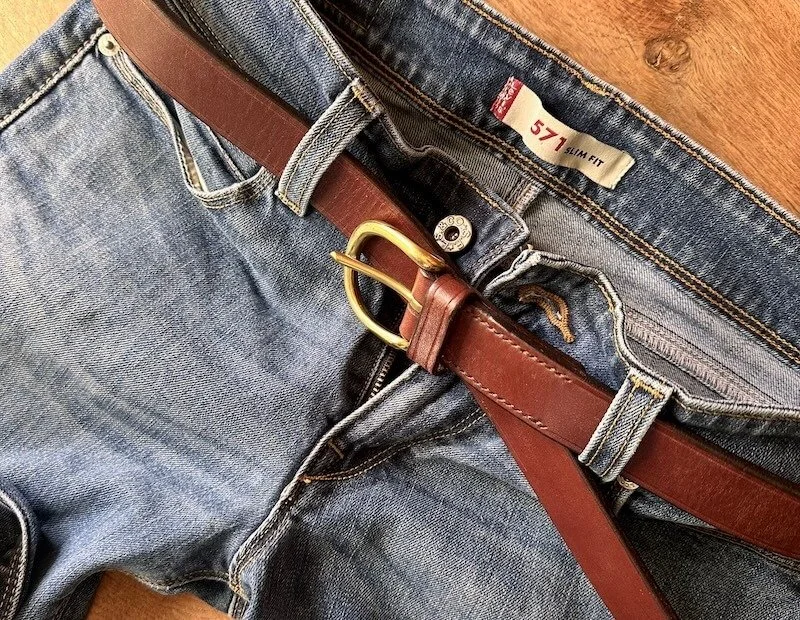
How to choose a belt for jeans
There are three useful things to think about when choosing a leather belt for jeans: the width of the belt, the leather it is made from and the buckle.
Width is probably the easiest place to start.
Most of the belts I make are either 1.25 inch or 1.5 inch wide. Both work with jeans, but they feel quite different when worn.
A 1.25 inch leather belt is a little narrower and neater. It works particularly well with smaller belt loops, lighter trousers and jeans where you don't want the belt to feel too substantial.
A 1.5 inch leather belt is the more traditional choice for jeans and workwear. It fills a standard jeans belt loop nicely and has a bit more presence around the waist. If you spend most of your life in jeans, work trousers and boots, this is generally the width I would steer you towards.
There isn't really a right or wrong answer, though. Much of it comes down to the clothes you wear and how substantial you like a belt to feel.
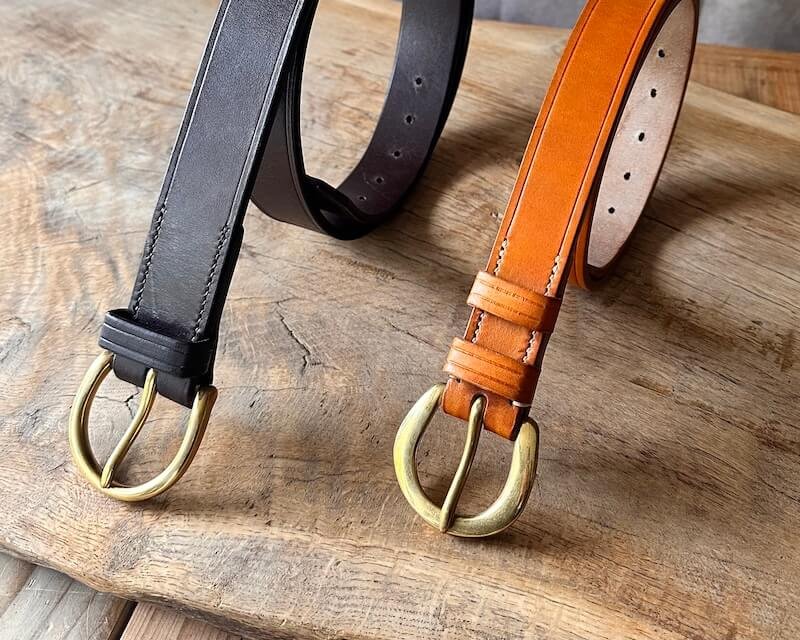
What makes a good belt for jeans?
For me, this matters far more than whether your belt perfectly matches your shoes.
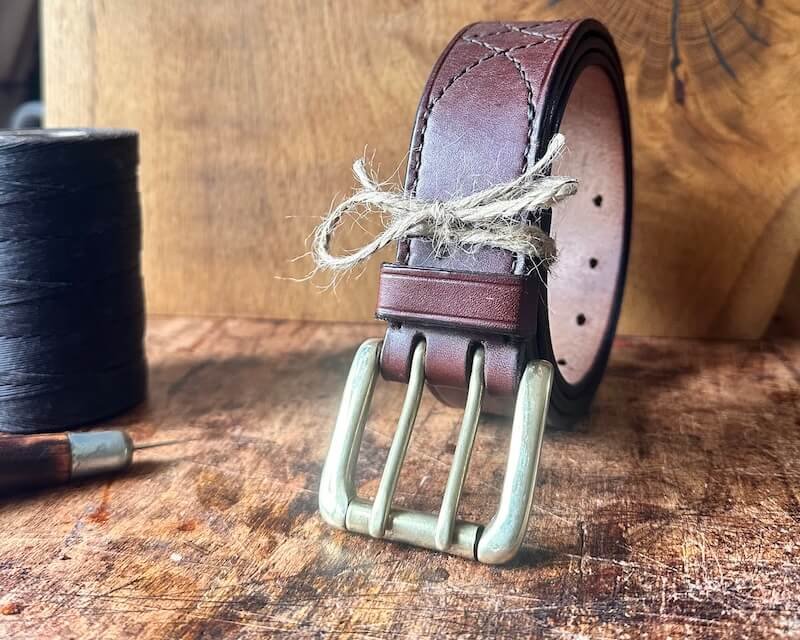
A good everyday belt needs to be made from leather that is substantial enough to hold its shape, but not so stiff that it feels uncomfortable. It needs a buckle that can stand up to years of being opened and closed, and it needs to be properly finished so that the edges don't become rough and unpleasant with wear.
My belts are made from British oak bark tanned bridle leather, traditionally tanned by J&FJ Baker in Devon.
Oak bark tanning is an extraordinarily slow process compared with modern industrial tanning. The hides spend many months in the tannery, gradually moving through pits containing increasingly strong tanning liquors made using oak bark.
It isn't the quickest way of making leather – which is rather why I like it.
The result is a dense, strong vegetable-tanned leather that is particularly well suited to things such as handmade leather belts, saddlery and other pieces that need to withstand repeated use.
It is also a leather that changes.
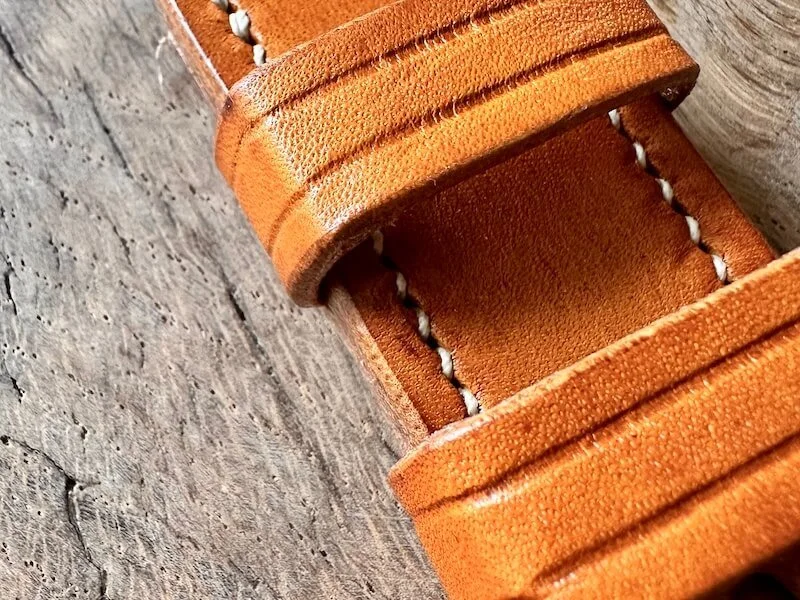
When a new belt leaves my workshop it will be relatively firm and structured. As it is worn, the fibres begin to flex and the leather gradually moulds to the person wearing it. The surface picks up marks, oils and small changes in colour and develops what we call a patina.
That ageing process is one of my favourite things about working with good leather. I don't really want one of my belts to look untouched five years after I've made it. I want it to look as though it has been used.
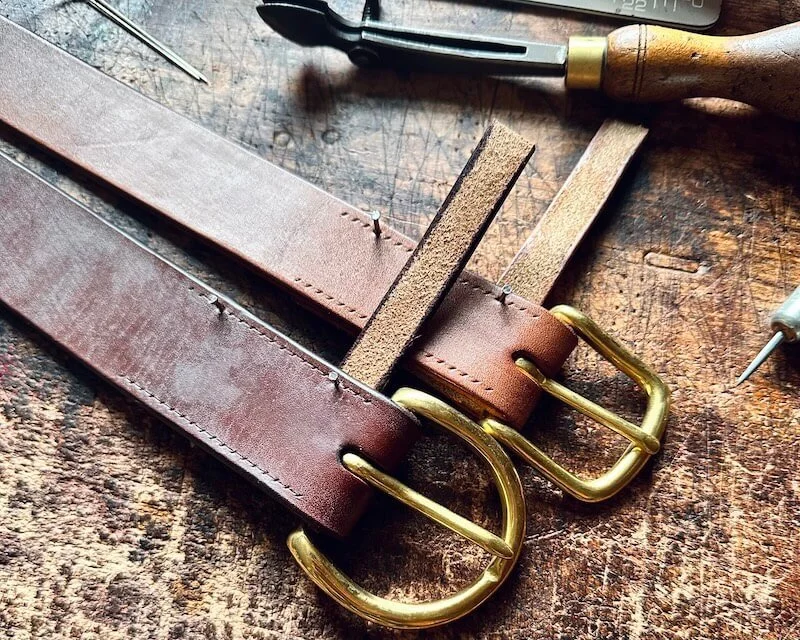
Choosing between black, brown, tan and natural leather belts
Colour is much more personal.
A black leather belt is perhaps the simplest choice if you regularly wear black boots, darker denim or black jeans. It tends to stay visually quite quiet and works with almost anything.
Brown leather belts are probably the most versatile option for everyday jeans. Dark brown works particularly well with indigo and mid-blue denim and sits comfortably with most brown leather boots and shoes.
A tan leather belt has a little more contrast and, because it starts lighter, you tend to see the ageing of the leather much more clearly. Over time, tan vegetable-tanned leather can deepen considerably in colour, particularly in the areas that are handled most often.
Natural leather takes that idea even further. It begins very pale and gradually darkens through light, handling and use.
If you love seeing leather change, tan and natural are wonderful choices. If you would rather your belt remained more consistent in colour, I would choose dark brown or black.
Does your belt need to match your shoes?
Not exactly.
You will often hear that your leather belt should match your shoes, and there is certainly some sense in that – particularly with formal clothing.
With jeans, I think you can relax a little.
A black belt with black boots will always work. Likewise, a brown leather belt and brown boots will naturally sit well together. But they don't need to be precisely the same shade of brown.
I would think about the overall balance instead.
Dark indigo jeans with brown boots and a dark brown belt are an easy combination. Faded blue jeans can look lovely with tan leather. Black denim works naturally with a black belt, although dark brown can work just as well if the rest of what you are wearing carries those warmer colours.
A belt is a practical object first. I wouldn't make choosing one more complicated than it needs to be.
What width belt is best for jeans?
If you have come here looking for the simplest answer, I would say 1.5 inches is a very good everyday belt width for jeans.
It is substantial without being cumbersome and works particularly well with denim, workwear and heavier boots.
A narrow leather belt, around 1.25 inches, gives a slightly lighter appearance and can be useful if the belt loops on your trousers are smaller.
Before ordering any belt, though, check the loops on the trousers you intend to wear it with. Belt loops aren't universal and there is little point buying a beautiful 1.5 inch belt only to discover your favourite trousers have 1.25 inch loops.
It sounds obvious, but it is very easily overlooked.
How to measure for a leather belt
This is one of the most important parts of ordering a belt, particularly if you are buying a custom belt or a belt made specifically to your measurements.
Please don't simply order your trouser size.
Trouser sizing varies enormously between brands and the number printed inside your jeans doesn't necessarily correspond to the measurement I need to make your belt.
The most reliable method is usually to take a belt you already own that fits comfortably and measure it from the point where the leather folds around the buckle to the hole you actually use.
That gives me a real measurement based on something you already know fits you.
My belts are individually cut to the measurement supplied rather than taken from a shelf of standard-sized belts, so it is worth spending a couple of minutes measuring carefully before ordering.
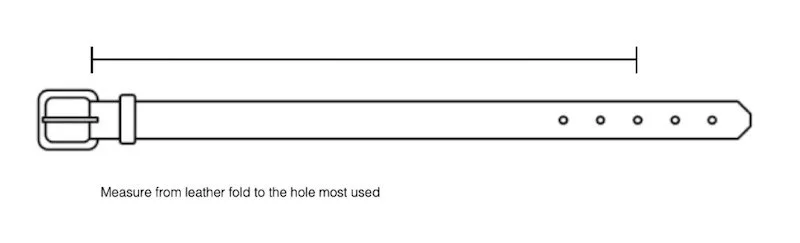
Getting the measurement right is important, particularly as every belt I make is made to the size you give me. I’ve put together a simple guide showing exactly how to measure a belt you already own so you can order with confidence.
Read my full belt measurement guide →
The buckle matters too
A buckle is doing quite a lot of work over the lifetime of a belt.
Every time you put your belt on, the buckle is pulled against the leather. The tongue moves through the same holes and the frame takes the tension from the strap.
This is why I use solid brass hardware.
Solid brass doesn't have a surface coating that eventually flakes away to reveal a different metal underneath. Instead, it changes gradually with use, just as the leather does.
New brass can be quite bright, but over time it dulls and develops its own patina. You can polish it back if you prefer it bright, or leave it completely alone and allow it to age naturally.
For an outdoor belt or workwear belt, I particularly like that. Leather and brass are both materials that show their age rather than trying to hide it.
Why leather thickness matters
Width is only one part of making a good belt. Thickness matters too.
The belts I make are generally around 4–5 mm thick. That gives them enough substance to hold their shape and withstand daily wear without making them unnecessarily bulky.
But thicker doesn't automatically mean better.
Leather is a fibre structure, and the quality and density of those fibres matter enormously. A very thick piece cut from a loose, stretchy part of a hide won't necessarily make a better belt than a slightly thinner piece taken from a dense, strong area.
This is one of the reasons leather selection is such an important part of making.
When I cut belts, I am not simply looking for a strip of leather the correct width. I am looking at the hide itself: the direction and density of the fibres, the surface, any natural marks and how that particular piece of leather feels in my hands.
Natural material isn't completely uniform, and I don't think we should expect it to be.
How a quality leather belt should age
One of the great advantages of a quality leather belt is that it doesn't need to remain looking new in order to look good.
Quite the opposite.
The bend near the buckle will soften. The hole you use will begin to show. The surface will develop little scratches and changes in tone. A tan belt may become considerably darker. The brass will become less bright.
That isn't the belt wearing out. It is the belt wearing in.
There is an important distinction between patina and damage, of course. Leather that is extremely dry, cracked or tearing needs attention. But the normal marks of use are part of owning something made from a natural material.
I think we have become rather accustomed to replacing things as soon as they stop looking new. Good leather asks for a slightly different relationship. Look after it, repair it when necessary and allow it to show the life it has had.
Caring for a leather belt
A good genuine leather belt really shouldn't require a complicated care routine.
In fact, one of the most common mistakes is doing too much.
If your belt gets muddy, allow the mud to dry and gently brush or wipe it away. If it gets wet, let it dry naturally at room temperature rather than putting it beside a radiator or other direct heat source.
Depending on how often it is worn and the conditions it lives in, a small amount of leather balm once or twice a year is generally plenty.
You are trying to keep the fibres supple, not saturate them.
I make my own leather balm for the belts, bags and other vegetable-tanned leather goods I make in the workshop. You only need a very small amount – leather care is definitely one of those occasions where more is not necessarily better.
If you'd like to know a little more about looking after your leather, I've put together a full leather care guide covering cleaning, conditioning and the simple things you can do to help good leather last.
If your leather is starting to feel a little dry or simply needs some care, you can find the same balm I use here in the workshop below.
Are belts with jeans still in style in 2026?
I have to admit that trends aren't something I spend a great deal of time worrying about from my workbench.
A leather belt and jeans have been worn together for decades because they work together.
Denim is hard-wearing, practical and improves with use. Good vegetable-tanned leather behaves in much the same way. Put the two together and you have materials that can take the knocks of everyday life and often become more interesting as they age.
So yes, belts are still very much worn with jeans in 2026.
But I would be wary of choosing a belt because it happens to be fashionable this year.
Choose one because the width fits your jeans, the leather is good, the buckle is strong and you like it enough to imagine wearing it for the next ten or twenty years.
That, to me, is much more useful.
Choosing a handmade leather belt
If you are looking for a handmade leather belt, start with the practical things.
Check your belt loops. Think about whether you prefer a narrower 1.25 inch belt or a more substantial 1.5 inch belt. Look at the boots and shoes you actually wear rather than the ones sitting untouched in the cupboard. And think about how much you want to see the leather change over time when choosing your colour.
Then look at the materials.
Ask what leather the belt is made from. Is the buckle solid or plated? How thick is the leather? Can the belt be repaired? And, importantly, how should you measure yourself before ordering?
A belt is a wonderfully simple object. There isn't much to hide behind, which means the quality of the leather, hardware and making really matters.
Looking for a belt made this way? You can explore my full range of handmade leather belts, individually made in my Devon workshop from British oak bark tanned leather and solid brass hardware.
Explore handmade leather belts →
My oak bark leather belts
I make each of my belts individually in my Devon workshop using British oak bark tanned bridle leather and solid brass hardware.
They are cut, edged and finished by hand using many of the same traditional leatherworking skills I use in my saddlery and harness work.
They aren't intended to be kept for best.
They are leather belts for jeans, work trousers, walking boots, days in the workshop, trips to the pub, gardening, building, travelling and all the ordinary things that make up a life.
And because I make them individually, they are made to the measurement supplied rather than simply being pulled from a shelf of generic sizes.
For me, that is what a good everyday belt should be: simple, useful, repairable and made from materials capable of growing old well.
Quick FAQ
What kind of belt looks best with jeans?
For most people, a 1.5 inch vegetable-tanned leather belt is a very good place to start. It fills standard jeans loops nicely and works particularly well with denim and boots. If you prefer something slightly narrower, or have smaller belt loops, try 1.25 inches.
Should a belt match your shoes?
It doesn't need to match exactly. Black with black and brown with brown are easy combinations, but particularly with jeans I would concentrate on the overall balance rather than finding identical shades.
Is a brown or black belt better with jeans?
Both work. Black is particularly useful with black boots and darker clothing, while dark brown is extremely versatile with blue denim. Tan gives more contrast and will usually show its patina more noticeably.
What width belt should I wear with jeans?
A 1.5 inch belt is a classic width for jeans and workwear. A 1.25 inch belt gives a slightly narrower, lighter appearance. Always measure your belt loops before choosing.
How should I measure for a handmade belt?
Don't rely on your trouser size. The best method is to measure a belt that already fits you comfortably, from the buckle fold to the hole you normally use. Follow the full measurement guide before ordering.
How long should a good leather belt last?
There isn't a useful fixed number of years because it depends on the leather, construction and how the belt is used. A well-made vegetable-tanned leather belt made from good materials should be something you can use for many years, care for and repair rather than routinely replace.
A final thought
I spend quite a lot of my working life thinking about leather – probably considerably more than is reasonable.
But the funny thing is that the objects I like making most are often the simplest ones.
A belt is just a strip of leather and a buckle. There are no clever compartments or complicated patterns to distract from the materials. The leather has to be right, the buckle has to do its job and the making has to stand up to use.
Get those things right and there really isn't much else a belt needs to do.
Wear it. Mark it. Let it soften. Look after it occasionally and repair it if it ever needs it.
Hopefully, many years from now, it will look considerably less perfect than the day it left my workshop – and be all the better for it.